 GOLDSNIPER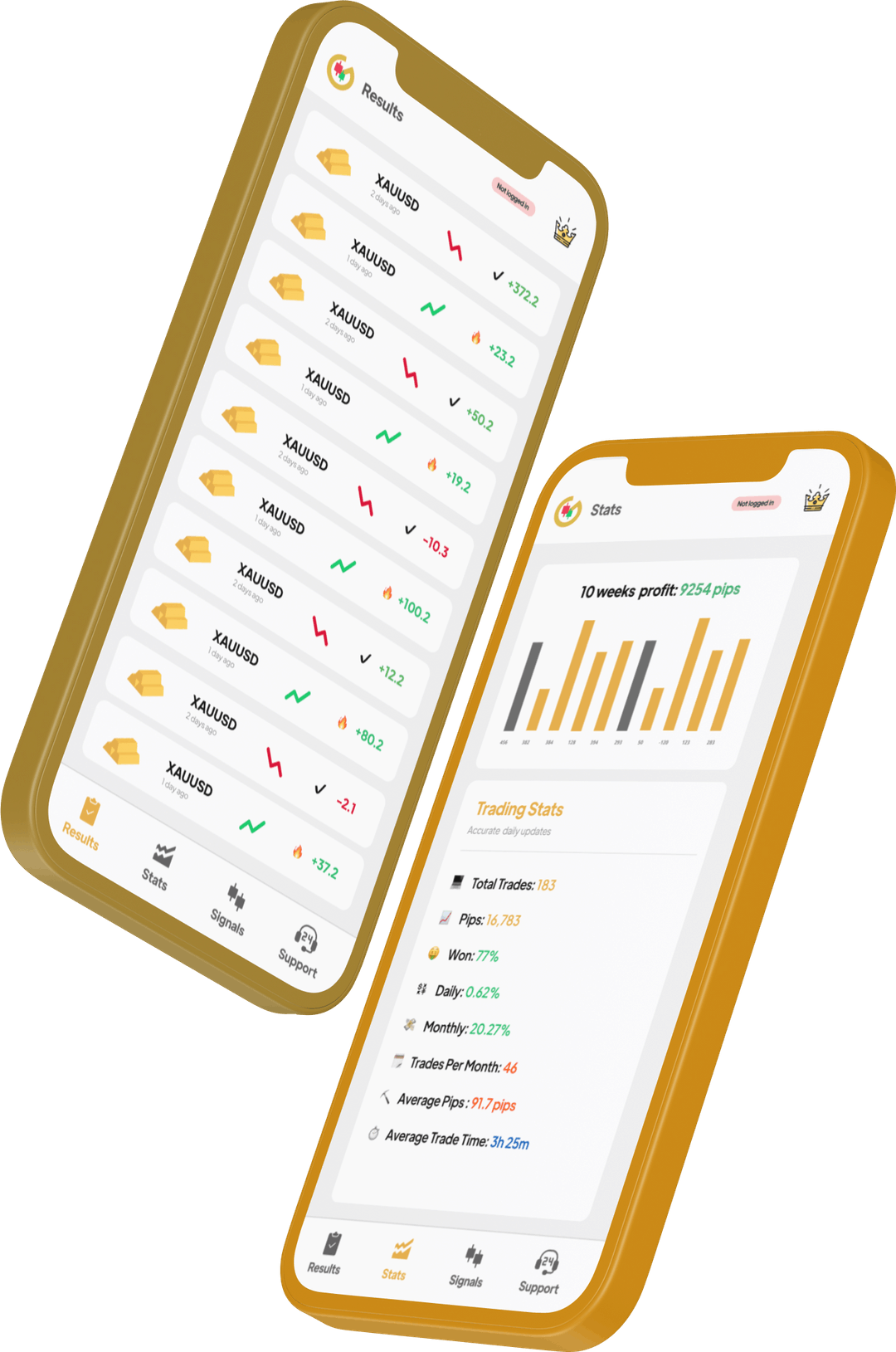
Gold trading (XAU/USD) is the practice of buying and selling gold against the US dollar in the forex and commodities markets. A beginner can start with as little as $100 using micro lots (0.01 = 1 oz of gold), where each pip movement equals $0.10. The key to success is mastering three things: choosing a regulated broker, understanding position sizing, and always using a stop-loss. GoldSniper's step-by-step signals make it easy for beginners to follow professional-level trades without years of experience.
What is gold trading?
Gold trading means buying and selling gold as a financial asset — not physical bars or coins, but contracts for difference (CFDs) or futures that track the price of gold against the US dollar. The ticker is XAU/USD, where XAU is the international currency code for one troy ounce of gold, and USD is the US dollar.
Why trade gold instead of forex?
Gold trends are often cleaner and more sustained than currency pairs. Gold tends to move in long directional legs driven by macro themes (interest rates, inflation, geopolitics) rather than the short-term noise that dominates forex. This makes it easier for beginners to identify and follow trends. Gold also has a strong correlation with the US dollar (DXY), real yields, and risk sentiment — giving you multiple tools to confirm trade direction. For gold-specific indicator settings that actually work on XAUUSD, see our TradingView indicators guide.
How gold trading differs from buying physical gold
When you trade XAU/USD CFDs, you don't own physical gold. You're speculating on the price movement. This gives you advantages: you can go short (profit when gold falls), use leverage to control larger positions with less capital, and enter/exit trades instantly with a click. The downside: leverage amplifies losses as well as gains, and you pay a spread (the difference between buy and sell prices) on every trade.
How to open a trading account.
Your broker is your gateway to the gold market. Choose wisely — a bad broker can make profitable trading nearly impossible through wide spreads, slippage, and poor execution. Here's what to look for:
Broker types: ECN vs Market Maker
ECN/STP brokers pass your orders directly to liquidity providers (banks, hedge funds). They charge a small commission per trade but offer raw spreads (as low as 0.0-0.1 pips on XAU/USD). Best for serious traders. Market maker brokers take the other side of your trade. They charge no commission but widen the spread to make money. Best for beginners with small accounts. If you're just starting, a market maker with tight spreads is fine — but as you scale, switch to ECN.
Regulation matters
Only trade with brokers regulated by Tier-1 authorities: FCA (UK), ASIC (Australia), CySEC (Cyprus), or FSCA (South Africa). Tier-2 regulators (FSA Seychelles, FSC Mauritius) offer lighter oversight but are acceptable if the broker also holds a Tier-1 license. Avoid unregulated brokers entirely — if something goes wrong, you have zero recourse. Check the regulator's website to verify the license number the broker displays.
What to check before depositing
XAU/USD spread on a standard account (should be under 0.30 pips on ECN, under 2.0 pips on standard), minimum deposit (many brokers now accept $5-10), available leverage (1:100 minimum, 1:500 maximum for non-EU clients), withdrawal speed and fees (should be free and processed within 24 hours), and whether they support MetaTrader 4 or 5 (the industry standard platforms). Test with a demo account before depositing real money.
Understanding XAU/USD — pips, lots, and leverage.
Before you place a single trade, you need to understand how the numbers work. Misunderstanding lot sizes or pip values is the fastest way to accidentally risk far more than intended.
Pips and pip value
A pip in XAU/USD is the third decimal place — a move from 3,000.00 to 3,000.01 is 1 pip. With a standard lot (1.0 = 100 troy ounces), 1 pip = $1.00. With a mini lot (0.1 = 10 oz), 1 pip = $0.10. With a micro lot (0.01 = 1 oz), 1 pip = $0.01 — but most brokers round this to $0.10 per pip for 0.01 lots. Always check your broker's specific pip value calculator. If gold moves 500 pips in a day (which is common), a standard lot moves $500, while a micro lot moves $5.
Lot sizes explained
Lot sizes in gold: Standard lot (1.00) = 100 troy ounces — one pip = approximately $1.00. Mini lot (0.10) = 10 troy ounces — one pip = approximately $0.10. Micro lot (0.01) = 1 troy ounce — one pip = approximately $0.01-0.10 depending on broker. Beginners should trade micro lots exclusively until they've been consistently profitable for at least 3 months. There's no shame in trading 0.01 — protecting your capital is the priority.
Leverage: the double-edged sword
Leverage lets you control a large position with a small deposit (margin). At 1:100 leverage, a $1,000 account can control $100,000 worth of gold. At 1:500, that same $1,000 controls $500,000. Leverage magnifies gains AND losses equally. A 1% move against you with 1:500 leverage wipes out your margin. The golden rule: never use more than 1:30 effective leverage. If you have a $1,000 account, don't open positions larger than 0.30 lots (approximately $30,000 notional value). Your broker might offer 1:500 — you don't have to use it. Think of maximum leverage like a car's top speed: just because it goes 200 mph doesn't mean you should drive that fast.
Your first trade — a complete walkthrough.
Fund your account
Deposit a modest amount ($200-500 is ideal). Do not deposit money you need for rent, bills, or emergencies — trading capital must be risk capital. Use a payment method with low fees: bank transfer or crypto deposits often have the lowest costs versus credit cards (which may add 2-5% fees). Verify that your deposit has arrived before moving to the next step.
Analyze the market
Check the daily chart first: what is the overall trend? Is gold above or below the 50 and 200-period moving averages? Are we near a major support or resistance level? Then check the economic calendar — any major data releases today (NFP, CPI, FOMC) that could cause volatility? If you use GoldSniper signals, this analysis is done for you — each signal is based on professional technical and fundamental analysis.
Set stop-loss and take-profit
Place your stop-loss at a logical level — not an arbitrary number of pips. A logical level is beyond a recent swing low (for longs) or swing high (for shorts), beyond a key support/resistance level, or beyond a round number that the market respects. Your take-profit should have at least a 1:1.5 risk-reward ratio (risking 50 pips to make 75). GoldSniper signals provide all three levels: entry, SL, and three progressive TPs.
Execute the trade
In MT4/MT5, right-click the XAU/USD chart and select "New Order." Choose your lot size (start with 0.01). Set your stop-loss and take-profit in the order window. Select "Buy" (long) or "Sell" (short). Double-check all numbers, then click "Place." The trade is now live. Do not stare at every tick — that leads to emotional decisions. Set alerts near your SL and TP levels and walk away.
Monitor with discipline
Check your trade once every 1-4 hours on the H1 or H4 chart. Do not watch the 1-minute chart — the noise will cause you to exit good trades prematurely. If the trade moves in your favor, consider trailing your stop-loss to lock in profit (move it to breakeven once you have 20+ pips of profit). Never widen your stop-loss — if the trade hits your SL, accept it and move on. There will always be another setup.
Review and journal
After the trade closes (win or loss), record: date, direction, entry/exit prices, lot size, P&L in dollars, reason for entry, what happened (did the trade follow your plan?), and what you would do differently. Review your journal weekly. Within a month, you will see patterns in your trading — both good habits to reinforce and mistakes to eliminate.
5 common beginner mistakes (and how to avoid them).
No stop-loss
The single most dangerous mistake. Trading without a stop-loss means one unexpected spike (NFP miss, geopolitical event, flash crash) can wipe out your entire account. Gold can move 1,000+ pips in minutes on major news. Always set a stop-loss — no exceptions. If you use GoldSniper signals, the SL is provided with every trade.
Fix: Set your stop-loss immediately when entering the trade. Use the "modify order" function in MT4/MT5, not a mental stop. Hard stops protect you from internet outages, platform crashes, and emotional override.
Overleveraging
Using 1:500 leverage on a small account means a 0.2% move against you wipes out your margin. Beginners often think high leverage = high profits, but it actually means high probability of ruin. A trader with 1:10 effective leverage survives drawdowns; a trader with 1:200 leverage gets liquidated on the first adverse swing.
Fix: Calculate your position size based on risk, not margin. If you have $1,000 and risk 1% per trade ($10), and your stop-loss is 100 pips, trade 0.01 lots (100 pips × $0.10 = $10 risk). Your available margin is irrelevant to this calculation.
Revenge trading
After a loss, the urge to immediately "get it back" is overwhelming. You jump into the next trade without analysis, increase your position size to recover faster, ignore your own rules, and usually lose even more. This is the pattern that turns a small loss into a blown account in a single day.
Fix: After ANY loss, step away for at least 30 minutes. Close the platform. Go for a walk. The market will still be there. Have a daily loss limit (e.g., 3% of account) — if you hit it, you are DONE for the day, no exceptions. Professional traders treat this rule as sacred.
Trading news blindly
Beginners hear "CPI is coming out, gold will spike" and enter before the release. But the market often moves violently in BOTH directions — stopping out both longs and shorts before settling on a direction. The initial spike is algorithmic; the real move comes minutes later. Trading news without understanding the expected vs actual numbers and market positioning is gambling.
Fix: Wait 5-15 minutes after major news releases before entering. Let the initial volatility and algorithmic reactions settle. Watch for a clear direction to emerge, then enter with the trend. Better yet, avoid trading 30 minutes before and after major news until you have at least 6 months of experience.
Wrong position size
Using the same lot size regardless of stop-loss distance means you risk wildly different amounts on different trades. A 0.10 lot with a 20-pip stop risks $2; the same 0.10 lot with a 200-pip stop risks $20. If you don't adjust your lot size based on stop-loss distance, you're essentially gambling on which trades happen to have tighter stops.
Fix: Use a position size calculator (GoldSniper has a free one at /tools/xauusd-position-size-calculator). Formula: Position size = (Account risk in $) / (Stop-loss in pips × Pip value per lot). For a $1,000 account risking 1% ($10) with a 100-pip SL: $10 / (100 × $0.10) = 1.0 or 1 micro lot of 0.01. Adjust for every trade.
Next steps on your gold trading journey.
Get GoldSniper Signals
Skip the analysis and follow professional-grade signals with entry, SL, and three TP levels. Start with the 7-day free trial — no payment required.
Start free trial →Learn Gold Strategies
Master the strategies professional traders use: trend following, breakout trading, support/resistance, and news trading for XAU/USD.
View strategies →Master Risk Management
Position sizing, risk-reward ratios, correlation risk, and how to protect your account. The difference between profitable and blown accounts.
Learn risk management →Understand XAU/USD
Deep dive into what XAU/USD is, how it differs from forex, market structure, lot sizes, pip values, and trading sessions.
Read the guide →Find the Best Broker
Compare regulated brokers for gold trading: spreads, commissions, leverage, platforms, and deposit methods. Updated for 2026.
Compare brokers →Trading Glossary
Every term explained: pip, lot, spread, leverage, margin, stop-loss, take-profit, slippage, swap, and more. Bookmark it.
Browse glossary →Watch how to place your first gold trade.
Step-by-step demo of MT4/MT5, from opening the platform to executing and managing a live XAU/USD trade.
Start trading gold with professional signals.
GoldSniper provides entry, SL, and TP levels on every signal. Download free — no payment required for the trial.